Key Biscayne's Median Price Is an Average of Two Different Islands
September 3, 2026
September 3, 2026
"If you want to live in Florida, near the water, it's expensive."
That's Sam Schrager, president of The Sands Condominium Association and head of the Key Biscayne Condominium Presidents' Council, describing what his building has been through: concrete restoration, a state-mandated push to add fire sprinklers to all 120 units, and the kind of maintenance cycle that never really ends. His comment wasn't about the island's reputation. It was about a bill.
That distinction matters more than most people shopping Key Biscayne realize. Before you get anywhere near a bill, your lender may already be treating your target condo differently than the one next door, and not because of your credit score. Florida requires a 25 percent down payment for a limited-review mortgage if the building doesn't have enough in reserves, full stop. As of early 2026, only 21 of the 2,397 condominium buildings across Miami-Dade, Broward and Palm Beach counties carried FHA approval, a sliver of the inventory. So two units on Key Biscayne, similar size, similar view, similar asking price, can require two completely different loans depending on what's sitting in a building's reserve account. That's not a market quirk. It's the mechanism.
Key Biscayne gets reported as a single housing market with a single median price, and that number is close to meaningless for anyone actually trying to buy or sell here. The island is really two markets that happen to share a zip code.
On one side sits single-family housing, and it's genuinely scarce. The Village of Key Biscayne, incorporated in 1991, enforces strict height limits and zoning controls that have kept the island free of high-rise construction outside its existing condo towers. New single-family construction is rare and mostly comes from teardown-and-rebuild projects on existing lots, not new subdivisions, because there's no undeveloped land left to subdivide. As of mid-2026, only around 31 single-family houses were listed for sale across the entire island, against roughly 89 condo units. That imbalance is structural, not seasonal. It's why single-family prices here have held a steady upward climb even as national headlines describe a cooling condo market.
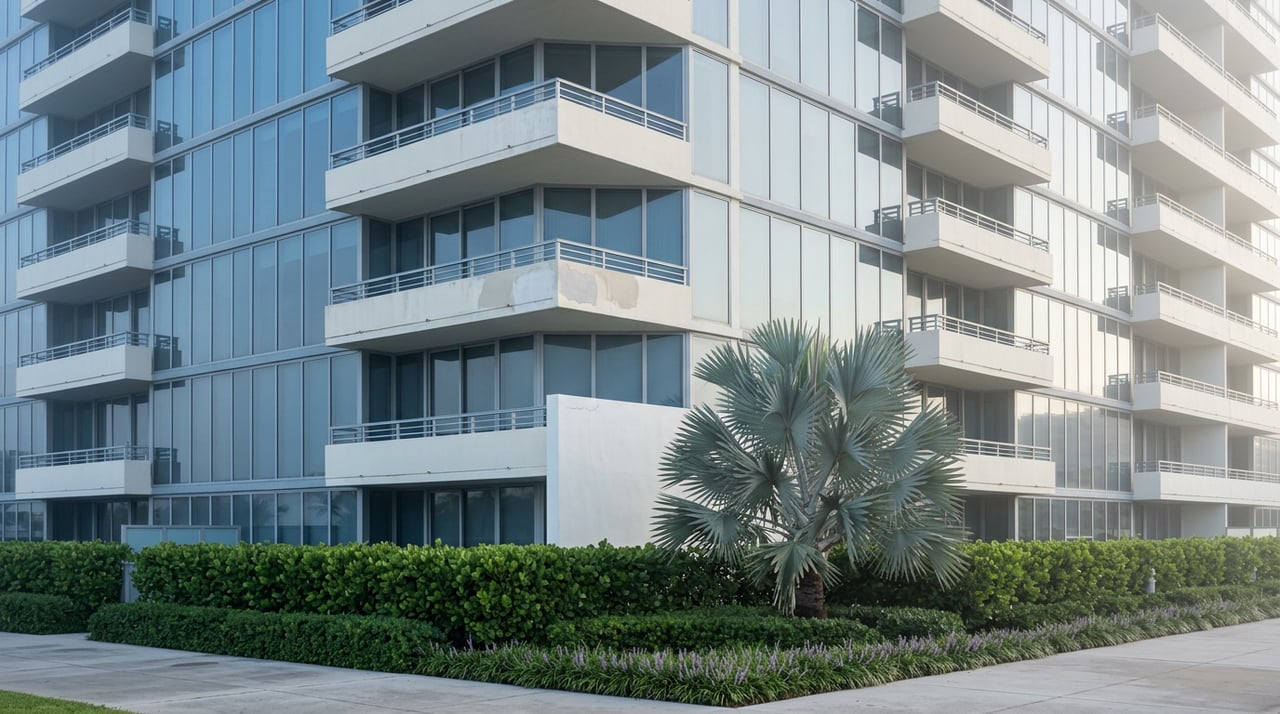
On the other side sits the condo segment, and it behaves nothing like the single-family side. Roughly seven in ten available properties on the island are condos, ranging from older one-bedroom units in 1970s towers to renovated residences in newer buildings like Grand Bay Residences or the Ocean Club. Condo pricing here isn't set primarily by finish level or floor. It's set by which side of a state law a given building happens to sit on.
Florida passed Senate Bill 4-D in 2022, in the wake of the Champlain Towers South collapse in Surfside, and expanded it in 2023 with SB 154. The law requires condo associations to commission Structural Integrity Reserve Studies and to fund reserves for major structural components rather than voting to waive or underfund them, which associations across the state had long been allowed to do.
State Rep. Vicki Lopez has clarified that SIRS-funded reserves had to appear in any association budget passed on or after January 1, 2025. Since most associations pass their budgets at the end of the calendar year for the one ahead, that meant condo fees on many buildings didn't reflect the new reserve requirement until January 2026. If your building's fees jumped this year and you're wondering why now, that's the answer. It isn't a one-time correction. It's the first full year of a law that's been on the books since 2022 finally reaching resident wallets.
Layered on top of SB 4-D is Miami-Dade County's building recertification program, which predates the 2022 law by decades. Under current county rules, coastal condo and co-op buildings three stories or taller built in 1998 or later must be recertified at 25 years and every 10 years after that. Buildings built before 1983 that already went through an initial recertification continue on their existing 40-year, then 10-year, schedule. Coastal buildings built between 1983 and 1997 had to complete recertification by December 31, 2024.
What that means in practice is that a building's age doesn't just affect how it looks. It determines which regulatory clock it's on, and that clock now drives insurance costs, reserve contributions and, ultimately, resale value.
The difference between a well-prepared building and an unprepared one isn't theoretical on Key Biscayne. It's visible in how two specific associations handled the same requirement.
The Sands, built in 1969 and the island's second-oldest condo tower after Island House, has already completed both its 40-year and 50-year recertifications. It's now in the middle of concrete restoration and installing fire sprinklers throughout all 120 units, a project Schrager describes as a genuine inconvenience for residents even though the building has stayed current on its obligations.
Oceansound, the largest condominium within the gated Key Colony community on the island's southern end, took a different path to the same finish line. Board president H. Frances Reaves has said the association began preparing for its 40-year recertification five years before it came due, hiring an engineering firm early to map out the work. When recertification arrived, Oceansound completed it without a special assessment or a jump in monthly fees, because the money had already been set aside.
Same law. Same island. Two entirely different experiences for the owners inside, and two entirely different stories for anyone trying to resell a unit in either building today. A beautifully renovated unit in a building facing a looming assessment will typically appraise and sell for less than a plainer unit in a building that planned ahead. The renovation isn't what a buyer's lender is worried about.
| Single-family homes | Condos | |
|---|---|---|
| Supply constraint | Zoning and finite land, capped by Village height limits | Reserve law reshaping building-by-building value |
| What sets price | Lot size, dockage, elevation, finish | Recertification status, reserve funding, special assessment history |
| Financing friction | Standard conventional lending | FHA approval rare; 25% down often required if reserves are short |
| Where value is heading | Steady appreciation on scarcity | Split between well-funded and underfunded buildings |
That table is the whole thesis in one place. Two segments, two different sets of rules, one reported median that blends them together and tells you almost nothing useful about either.
If you're looking at condos on the island, the finish and the view are the easy part to evaluate. The harder part is the building's paperwork, and it's worth asking for before you get emotionally attached to a floor plan.
None of these questions show up on a listing sheet. All of them show up in an estoppel letter or a set of board minutes, and all of them affect what you'll actually pay to close and what the unit will be worth when you sell.
Does this mean condos on Key Biscayne are a bad investment? No. It means the island's condo market rewards buyers and sellers who look at building-level financial health rather than the island-wide average. A well-funded building in a strong location remains a strong long-term hold.
Why is the single-family median so much higher than the condo median? Mostly because there are so few single-family homes to begin with. With roughly 31 houses available against nearly triple that in condos, a handful of high-end waterfront sales can swing the single-family median in ways that don't reflect the broader market.
Should I wait for condo prices to fully settle before buying? The recertification and reserve landscape is still working through its first full year of mandatory funding, which began in January 2026. Buildings that planned early, like Oceansound, have already absorbed the cost. Buildings that didn't are still catching up. Timing matters less than knowing which category your target building falls into.
The island's real estate market isn't confusing because the data is bad. It's confusing because two different markets are being reported as one. Once you separate them, the numbers actually tell you something.
If you're weighing a Key Biscayne purchase or thinking about what your current condo or home might be worth given where its building stands on recertification, Martina Kanianska can walk through the specific building or block you're considering and tell you what the paperwork actually says before you make an offer. Let's Connect.


Ready to find your dream home or make a smart investment? Reach out to Martina today! Passion ignites success - Martina’s love for real estate fuels her drive. She doesn’t just sell properties; she creates lasting connections. With Martina by your side, confidence is your greatest asset. Don’t wait, contact Martina now to start your journey towards success!
601 Brickell Key Dr. Miami, FL 33131